


Request for Proposals: IFA x Women of Vaastukala Archive | Deadline Extended: February 20, 2026 (CLOSED)
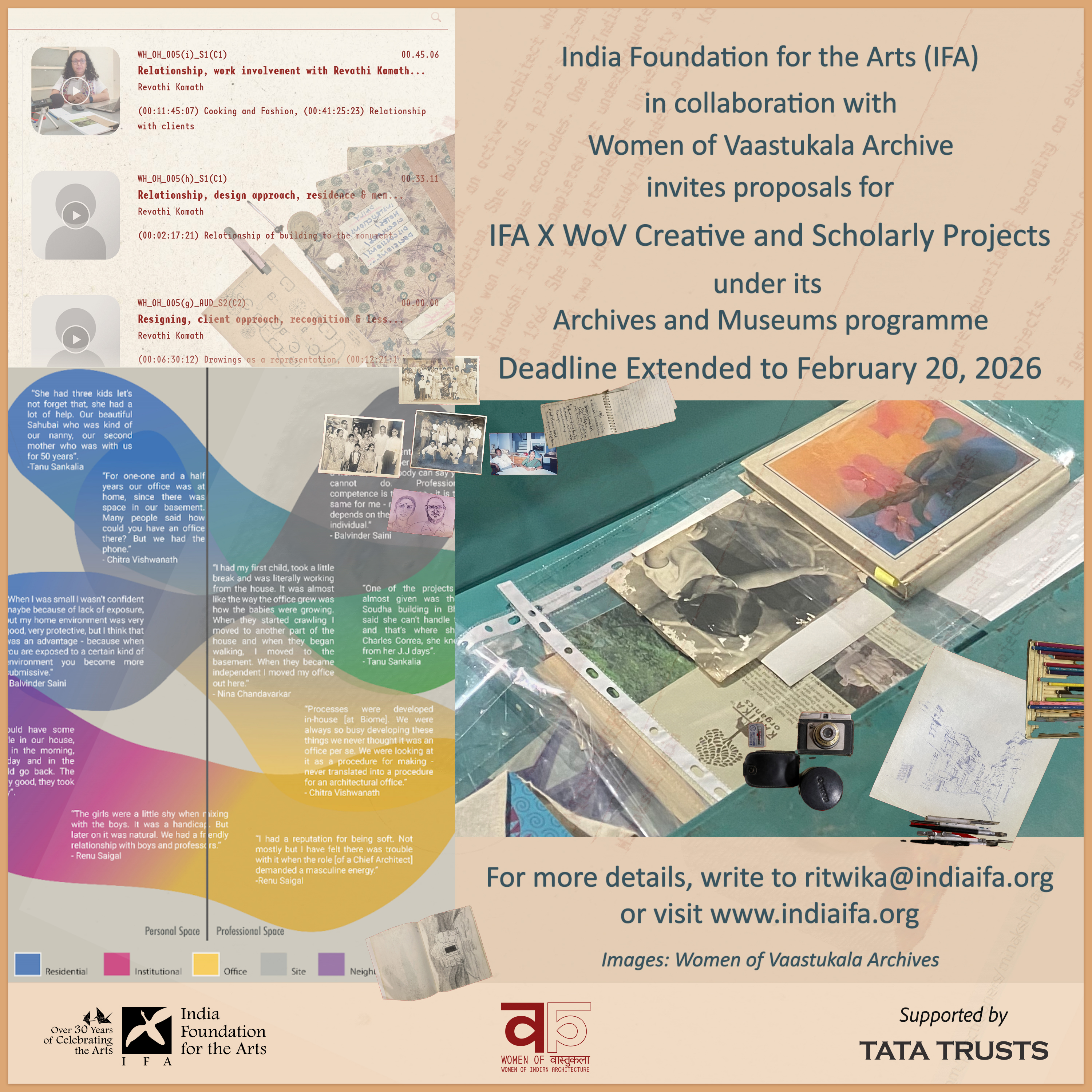
India Foundation for the Arts (IFA), in collaboration with the Women of Vaastukala Archive, India, invites applications for IFA-Women of Vaastukala Creative and Scholarly projects, under our Archives and Museums programme. The programme has a twofold objective: to provide arts practitioners and researchers with an opportunity to generate new, critical and creative approaches for public engagement with archives and museum collections; and to energise these spaces as platforms for dialogue and discourse. Read about earlier projects under this programme.
About Women of Vaastukala Archive
Announced as accessible in 2022, the archive is primarily located on the web and hosts oral histories of 21 women practitioners in architecture, design, planning, and allied disciplines, from across India. Supported by the Graham Foundation, Chicago, this archive has emerged from a research project Revisiting India’s Architectural History: Tracing the Women Practitioners of Twentieth Century India. The intent is to record conversations with a wide range of women practitioners in varying positions across the built environment industry, map their journeys, and arrive at an alternate narrative about India’s architectural history post-independence. The archive was launched in Ahmedabad with an exhibition Vandalising the Indian Atelier: in search of stories of women practitioners (2023) at Arthshila. The archive was also launched in Kochi and Bengaluru at the IIA-YAF and IIID forums, respectively, focusing on different issues related to gender studies, archiving, and spatial design.
The archive is now supported and hosted by Curating for Culture, a collective focused on making invisible histories visible. Incorporating the personal narrative, approaching the frameworks of archiving through community engagement, and public interpretation have been pivotal to the collective practice.
About the Collection
The Archive has audio formats of oral histories, titled and mapped into smaller sound clips, that were primarily recorded over online platforms or in person. They trace the journeys of women architectural practitioners from twentieth-century India and map their architectural contributions as significant landmarks in the larger narrative of India’s architectural history with an intention to shift the popular narrative.
Why? The well-known account of India’s twentieth-century architectural history is largely articulated around the contributions of male architects and engineers. There has been very little documentation and dissemination about the contributions made by women architects or female practitioners in other positions from the country. Existing narratives about Indian architectural history are also influenced by geographical and sociopolitical boundaries. Using oral history recordings, visual documentation, and storytelling tools, the Women of Vaastukala Archives creates an open-access archive and contributes to the discourse about the relationships between gender and the built environment in India.
Some of the women practitioners who have participated so far are Balvinder Saini, Chitra Vishwanath, Falguni Desai, Gauri Virdi, Gita Balakrishnan, Leena Kumar, Madhu Sarin, Madhavi Desai, Minakshi Jain, Nalini Thakur, Nina Chandavarkar, Parul Zaveri, Punita Mehta, Renu Saigal, Sheila Sri Prakash, Veena Garella. The scope of the project has also expanded in terms of collecting peripheral voices from people associated with women practitioners who are not around anymore. Interviews were conducted with clients, family, and friends of the late architect Hema Sankalia, Tara Chandavarkar, and Revathi Kamath, to put their lived histories together.
How? The recordings at the Archive have been made with the intention of presenting a first-person perspective of the interviewee to the listeners, readers, and researchers and the data is edited only for basic sound cleaning and redaction of sensitive information.
This is also one of the first or very few oral history archives that has attempted to make the expansive data searchable through a content management system. In this process, two important tools that have been instrumental are: mapping the metadata and keywords, and summarising each session into short summaries or highlighting key narratives.
Previous Interventions by the WoV Archive
Even when the archive was still being curated, quite a few research and interpretative exercises were pursued:
- A poster titled Negotiating Between the Personal and Professional at the Feminist Collective in Architecture conference (2022) in Ahmedabad at the Mill Owner's Association
- A proposition Visualisation of Oral Histories was presented at the 7th OHAI Conference on Oral History in the Digital World and
- A three project panel titled Curating oral history projects for public engagement by Curating for Culture (2022).
The Archive, its processes, and its implications have also been invited to exhibitions or critically discussed across significant national and international initiatives:
- “Collection of Readings from the exhibition Vandalising the Indian Atelier” in Women Writing Architecture. Published September 08, 2025
- “AGAINST THE GRAIN: Women Architects Rereading and Reimagining the Archive and Monograph" by Mary Norman Woods in Women and Architectural History: The Monstrous Regiment Then and Now, edited by Dana Arnolds. Routledge, 2024.
- “Women of Vaastukala Archive” in Feminist Spatial Practices. Published July 18, 2025
- Samatva: Shaping the Built, India's first Art, Architecture, and Design Biennale (IAADB), curated by Swati Janu, organised by the Ministry of Culture at Red Fort, 2023-24.
- “Collecting stories of women of Indian architecture” by Ishita Shah in AS Architecture Suisse, AS 226 3 - 2022/2023.
About the Scope of the Creative and Scholarly Projects
Curating for Culture is working towards creating a forum (read: community space) in India, tentatively in the winter of 2026. The intentions behind the WoV Archive and its impact will be at the core of the forum, while the other thematic areas of interest are:
- feminist spatial practices
- community engagement for cultural preservation
- the need for spatial resilience in India’s urban development
We invite applicants to bring their interpretations, collaborate, and co-curate the forum with us.
For the Creative Projects, we encourage proposals that
- initiate and implement digital-born projects and/or multimedia outcomes; prototypes or small-scale interventions for social media communications, and long-term output(s) for an exhibition or spatial engagement.
- reimagine the oral history collection and associated physical archives from the past exhibition through artistic interventions.
- interpret concepts of fragmented archives, gender in architecture, cultural resilience, and feminist spatial practices across the country.
For the Scholarly Project, we encourage proposals that
- create new interviews with women practitioners who are not necessarily in leadership positions across the spatial design and built environment industry.
- study and interpret the existing collections to compare and contrast the lived experiences, emerging values, and design processes, and map the shifts within the larger industry.
- cross-polinate with secondary resources to arrive at nuances about cultural resilience in feminist spatial practices across the country and extend the reading across South Asia.
- The research outcomes will be co-curated for upcoming exhibitions, the audio-visual recordings will be included in the digital archive with consent clearance, and the ethical guidelines or research paper will be co-published in relevant publications.
For more information about the collections and materials available for research, please contact Ishita Shah at info@curatingforculture.
Duration of the Project: 09-15 months. Project Coordinators must have at least some tangible outcome(s) to be a part of the forum in the winter of 2026.
Budget
- The project cost should not exceed Rs 3,00,000/-
- You can request for an honorarium not exceeding 35% of the proposed budget for the entire duration of the project. The total amount is inclusive of the honorarium.
- Funds will cover only project-related costs and activities, and will not pay for infrastructure costs or equipment purchase.
Who Can Apply?
We seek applications from curators, artists, art-educators, researchers, writers, performers, as well as other creative practitioners, and scholars with a background in research and a keen interest in working with archival collections, oral histories, gender issues, and the history of spatial design or built environment in India.
Eligibility
- Only Indian nationals can apply. This does not include PIO (Persons of Indian Origin) and OCI (Overseas Citizen of India) Card Holders.
- Applicants must have a PAN card and one of the following for proof of identity and citizenship – Indian Passport or Aadhar Card or Voter’s ID in India.
- Only individuals can apply. Organisations of any kind cannot apply.
- If there are collaborators in the projects, they must also be Indian nationals.
- Persons who have a past history of financial delinquency with IFA are not eligible.
- Persons who have failed to deposit at IFA agreed deliverables from an earlier IFA grant are not eligible.
- Persons who have previously received a letter from IFA disallowing them from applying in the future for any reason are not eligible.
- Persons currently working on a project implemented by IFA are not eligible to apply.
- More than one individual can apply if they have a joint account. If they do not, then only one among them should apply with the others as collaborators.
Submission Guidelines
You can write your proposal in any Indian language, including English.
Send us the following in a single email:
- A proposal briefly describing the project (as described in the call with outlines of creative outcomes that one can imagine, or research questions if it is a Scholarly project) that could be developed from the materials mentioned above. The description should include the vision, approach and possible outcomes.
- A brief note on other public programmes that could be developed from the material.
- Detailed timeline for the project.
- Detailed budget.
- Your CV with a brief description of a project you have been involved with as a curator, arts practitioner, or researcher. This description should comprise the vision, processes, and outcomes from that project. Please send us a document with links and not attachments.
Email your application or any queries to Ritwika Misra at ritwika@indiaifa.org with the subject line: Application for IFA - Women of Vaastukala Archive
Key Dates
- Deadline for receiving applications: February 20, 2026
- Interviews with shortlisted candidates: March 2026
- The project will commence by March 2026 for a period of 15 months.
IFA will implement this project with you directly as Project Coordinator.
Please note that IFA is committed to creating a safe environment that supports, respects, and protects everyone, including children. The applicant must be aligned with this and must uphold it at all times.
The Archives and Museums programme is supported by Tata Trusts.
Images: Women of Vaastukala Archives